- Home
- About
- Application Scenarios
- Equipment Product Center
- Sheet metal enclosure processing
- News
- Contact us
- العربية
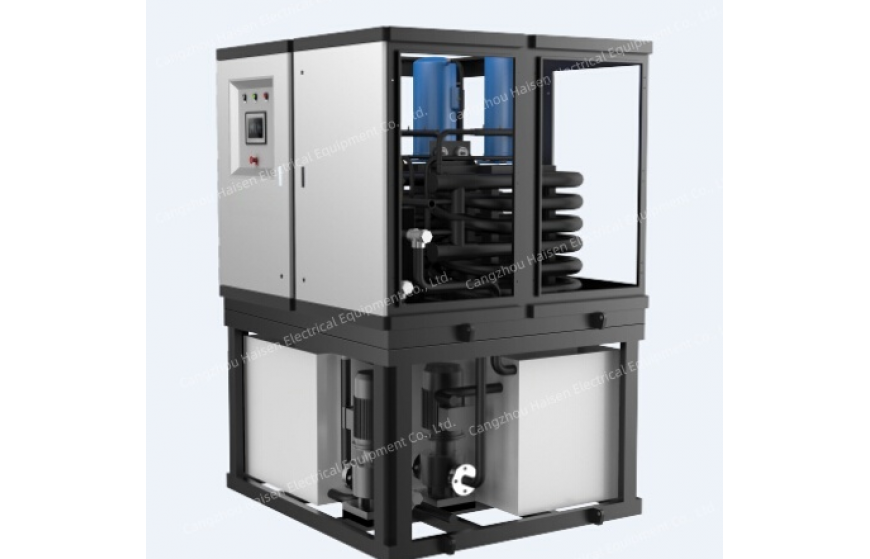
Industrial process heat pumps
I. What is an Industrial Process Heat Pump?
An industrial process heat pump is a large-scale heat pump system specifically designed for industrial production heating needs. The fundamental difference between this and conventional building heating heat pumps lies in their objectives—the goal is not environmental comfort, but rather to meet the precise requirements of industrial processes for high-temperature hot water, hot air, or even steam. These systems are widely used in drying, sterilization, distillation, cleaning, electroplating, and various other process applications.
Compared with traditional coal-fired, oil-fired, or electric heating boilers, industrial process heat pumps achieve heating by transferring low-grade heat from the air or industrial waste heat, delivering far higher energy efficiency than direct energy consumption methods.
II. Working Principle
Industrial process heat pumps operate on the reverse Carnot cycle, with a closed-loop system consisting of four main components: the evaporator, compressor, condenser, and expansion valve. The core concept is that the heat pump is able to upgrade "low-grade heat" from a low-temperature source into usable "high-grade heat"—and this upgrade magnitude is referred to as the "temperature lift."
In heating mode, the liquid refrigerant absorbs heat from a low-temperature source (such as air, water, or industrial waste heat) in the evaporator and evaporates into a low-temperature, low-pressure gas. The gaseous refrigerant then enters the compressor, where it is compressed into a high-temperature, high-pressure gas. This gas enters the condenser and condenses into a liquid, releasing the absorbed heat to the process medium (such as water, air, or thermal oil) for industrial use. After releasing its heat, the liquid refrigerant passes through the expansion valve to reduce pressure and returns to the evaporator to begin the next cycle. The entire process consumes only a small amount of electrical energy to drive the compressor.
To meet the large temperature lift requirements of industrial applications, several technical routes have been developed for process heat pumps:
Vapor compression heat pumps are the most mainstream type, achieving large temperature lifts through multi-stage compression, vapor injection enthalpy enhancement, or cascade cycles.
Absorption heat pumps use medium-temperature waste heat (e.g., waste heat above 60°C) as the driving energy, requiring no electrical power to drive the compressor—making them particularly suitable for factories with abundant waste heat resources.
Compression-absorption hybrid heat pumps combine the advantages of both technologies, capable of adapting to low-temperature heat sources while outputting high-temperature heat, though the system configuration is more complex.
III. Core Features
High Efficiency and Low Operating Costs:
The Coefficient of Performance (COP) typically ranges from 3.0 to 6.0—meaning that for every unit of electricity consumed, 3 to 6 units of heat energy are produced. The overall efficiency is far higher than coal-fired boilers (typically 65%–85%) and electric heating equipment (typically ~95%), significantly reducing factory energy expenses.
Green and Low-Carbon for Environmental Compliance:
The system achieves electrification of process heating, and when powered by green electricity, can achieve near-zero carbon emissions. Environmentally friendly refrigerants are used to meet international environmental agreements' greenhouse gas reduction requirements, helping factories respond to increasingly stringent carbon regulations and green trade barriers.
Precise Temperature Control for Process Quality:
The intelligent control system can maintain outlet water or air temperature accuracy within ±1°C of the set value—meeting the high precision requirements of pharmaceutical, food, chemical, and other industries, effectively ensuring consistent product quality.
Waste Heat Recovery for Cascaded Energy Utilization:
The system can effectively recover low-temperature waste heat (typically 40°C to 80°C) discharged in large quantities from industrial processes—such as cooling water waste heat, air compressor waste heat, and flue gas waste heat—and upgrade it into usable thermal energy. This achieves cascaded energy utilization and further improves the overall energy efficiency of the factory.
High Safety and Easy Maintenance:
Compared with coal-fired or gas-fired boilers, heat pump systems involve no open flames, no fuel storage, and no risk of explosion or poisoning—ensuring high operational safety. Core components such as screw compressors have design service lives of tens of thousands of hours, and with intelligent fault diagnosis systems, the equipment ensures long-term stable operation with far less maintenance work than traditional boilers.
IV. Main Applications
Industrial process heat pumps are widely used in industries requiring large quantities of medium-to-low temperature heat energy:
Food and Beverage Industry: Pasteurization, cleaning, spray drying (e.g., milk powder production, fruit juice concentration, meat processing), and other processes.
Chemical and Pharmaceutical Industry: Reactor heating, distillation column heat supply, material drying, and solvent recovery.
Papermaking and Textile Industry: Pulp drying, fabric setting, and dyeing process heating.
Metal and Surface Treatment Industry: Cleaning tank heating, phosphating treatment, electroplating processes, and more.
Oil Extraction and Mining: Crude oil heating, pipeline tracing heating, and mine site building heating.
Popular recommendation