- Home
- About
- Application Scenarios
- Equipment Product Center
- Sheet metal enclosure processing
- News
- Contact us
- العربية
Modular air source heat pump
I. What is a Modular Air Source Heat Pump?
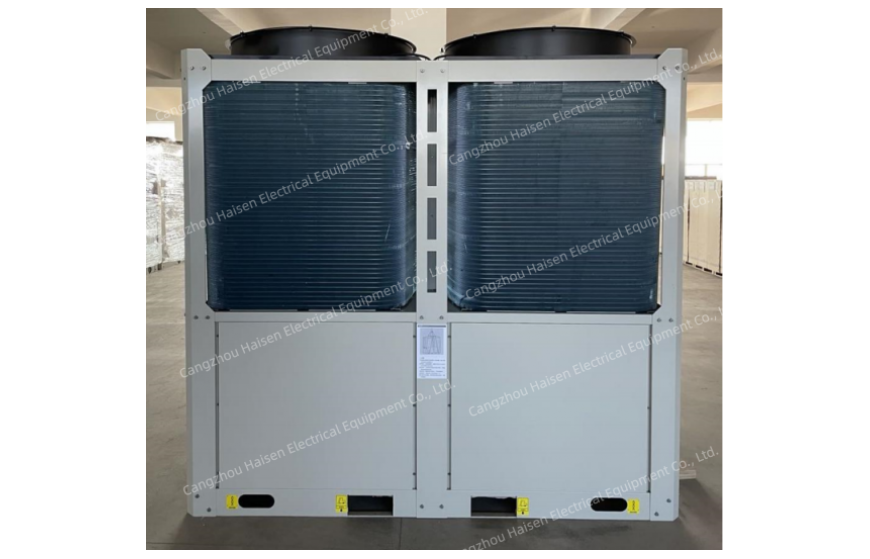
A modular air source heat pump is a system that splits the traditional integrated heat pump unit into multiple independent standard modules. Each module is equipped with a complete set of core components—including a compressor, heat exchanger, expansion valve, and others—and can independently perform heating or cooling cycles. These modules are connected in parallel through an intelligent control system to collectively meet the building's cooling and heating demands.
This modular design allows the heat pump system to be flexibly configured like building blocks. The number of modules can be selected based on actual load requirements, and the system can be expanded at any time. This makes it particularly suitable for projects that require phased investment or have growing load demands over time.
II. Working Principle
The modular air source heat pump operates on the reverse Carnot cycle, with a closed-loop system consisting of four main components: the evaporator, compressor, condenser, and expansion valve.
In heating mode, the liquid refrigerant absorbs heat from the outdoor air in the evaporator and evaporates into a low-temperature, low-pressure gas. The latent heat of vaporization absorbed in this process is the heat recovered from the air. The gaseous refrigerant is then compressed by the compressor into a high-temperature, high-pressure gas, which then enters the condenser and condenses into a liquid, releasing the absorbed heat to the circulating water or heating terminal. The liquid refrigerant then passes through the expansion valve, where it expands and reduces in pressure, returning to the evaporator to begin the next cycle. This process repeats continuously, extracting low-grade thermal energy from the air and outputting it as usable medium-to-high-temperature heat.
The entire process consumes only a small amount of electrical energy to drive the compressor, resulting in far superior energy efficiency compared to direct electric heating methods.
III. Core Features
Flexible Modular Combination:
The system can consist of multiple modules connected in parallel, with up to 16 or even 32 modules in a single group. Total cooling or heating capacity can be flexibly expanded to meet different project scales—from small and medium-sized commercial buildings to large centralized heating projects. Multiple-stage capacity regulation is available (e.g., 25%, 50%, 75%, 100%), enabling precise matching of building real-time load.
Mutual Backup for Reliable Operation:
With multiple modules running in parallel, if one module fails, the remaining modules continue to operate. The system only experiences partial capacity reduction rather than complete shutdown, effectively ensuring continuous energy supply for critical loads. During maintenance and repair, the faulty module can be isolated independently without affecting overall system operation.
High Energy Efficiency:
Advanced technologies such as full variable frequency drives are employed. The integrated COP can reach a high level, with some high-efficiency series products achieving an integrated COP of up to 4.80. The system automatically adjusts the number of operating modules and their operating status based on actual cooling and heating loads, avoiding frequent start/stop cycles and low-efficiency operation of large units under partial load conditions—significantly reducing operating costs.
Wide Operating Range:
Advanced products have achieved stable operation in ultra-low temperature environments. The minimum operating ambient temperature for heating can reach as low as -30°C, with a maximum outlet water temperature of up to 62°C—making the system suitable for the winter and summer climate conditions across most of China. The cooling operating range is equally broad, with stable operation throughout the year at ambient temperatures ranging from -27°C to +50°C.
Easy Installation and Space Saving:
Single modules are compact in size and light in weight, making them easy to transport and hoist. They can be installed directly on open rooftops or outdoor ground areas without requiring a dedicated machine room, effectively saving valuable building floor space. When multiple modules are joined, standardized piping and electrical interfaces allow for rapid connection, simplifying on-site construction.
Intelligent Control:
Equipped with a full-color touchscreen intelligent control system or wired controller, operation is intuitive and user-friendly. The system features protective functions including intelligent defrosting, multiple freeze protection, and balanced operation. When one module undergoes defrosting, it does not affect the heating of other modules, ensuring stable outlet water temperature.
IV. Main Applications
Modular air source heat pumps are widely used in central air conditioning systems for comfort applications such as hotels, shopping malls, and office buildings. They are also suitable for heating systems with high heating demand, such as hospitals and centralized residential communities, as well as central hot water supply for commercial establishments like schools, hotels, and chain restaurants. Additionally, they play a significant role in industrial process heating and agricultural drying.
Popular recommendation