- Home
- About
- Application Scenarios
- Equipment Product Center
- Sheet metal enclosure processing
- News
- Contact us
- العربية
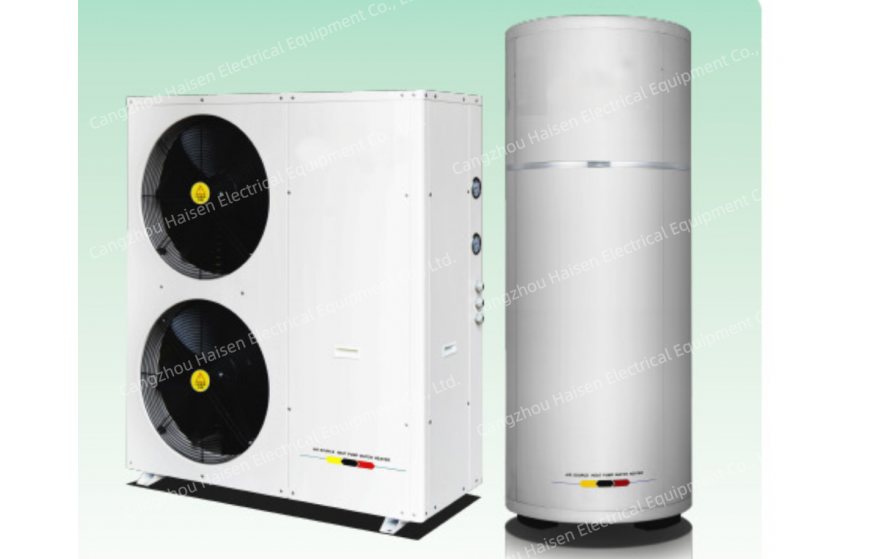
Air Source Heat Pump for Home Use
I. What is an Air Source Heat Pump?
An air source heat pump is a highly efficient energy-saving device. Think of it as a heat "mover": it consumes a small amount of electrical energy to "move" invisible heat from the outdoor air into your home for space heating, domestic hot water production, or cooling.
Its operating principle is based on the reverse Carnot cycle, which is essentially the same process used in air conditioners and refrigerators. Inside the heat pump is a closed-loop system consisting of key components such as a compressor, condenser, and evaporator. In simple terms, the liquid refrigerant absorbs heat from the surrounding air in the outdoor unit's evaporator and evaporates into a gaseous state. The gaseous refrigerant is then compressed by the compressor into a high-temperature, high-pressure gas—a process that consumes electrical energy. Finally, this high-temperature gas releases its heat to water or air in the indoor unit's condenser for heating purposes, while the refrigerant itself cools down and condenses back into a liquid, returning to the outdoor unit to begin the next cycle.
II. Key Advantage: High Energy Efficiency
The greatest advantage of this heat "moving" approach is its extremely high energy efficiency. The Coefficient of Performance (COP) is a common indicator used to measure heat pump efficiency, representing how many units of heat energy are produced for each unit of electrical energy consumed.
The COP of an air source heat pump typically ranges from 3 to 5. This means that for every 1 kWh of electricity consumed, it can move the equivalent of 3 to 5 kWh of heat energy—far superior to electric heaters, which directly convert electricity into heat.
III. Applications and Common Uses
Thanks to its high efficiency and environmental friendliness, air source heat pumps are now widely and diversely applied. You may have already encountered them in daily life: the cooling and heating air conditioners used in many homes are the most common form of air source heat pumps. When operating in heating mode, they extract heat from outdoor air and deliver it indoors.
In addition, they are widely used for:
Producing domestic hot water for homes and commercial establishments
Providing comfortable underfloor heating for residential buildings
Agricultural drying
Industrial process heating
IV. Technical Considerations
There are some technical points to consider. For example, during severe cold and humid winters in northern regions, frost may accumulate on the surface of the outdoor unit's heat exchanger, which can reduce efficiency. This requires the equipment to be equipped with intelligent defrosting functionality.
V. Summary
In summary, the air source heat pump is a mature, widely adopted, and highly energy-efficient heating and hot water solution, particularly well-suited for applications that require both cooling and heating.
Popular recommendation