- Home
- About
- Application Scenarios
- Equipment Product Center
- Sheet metal enclosure processing
- News
- Contact us
- العربية
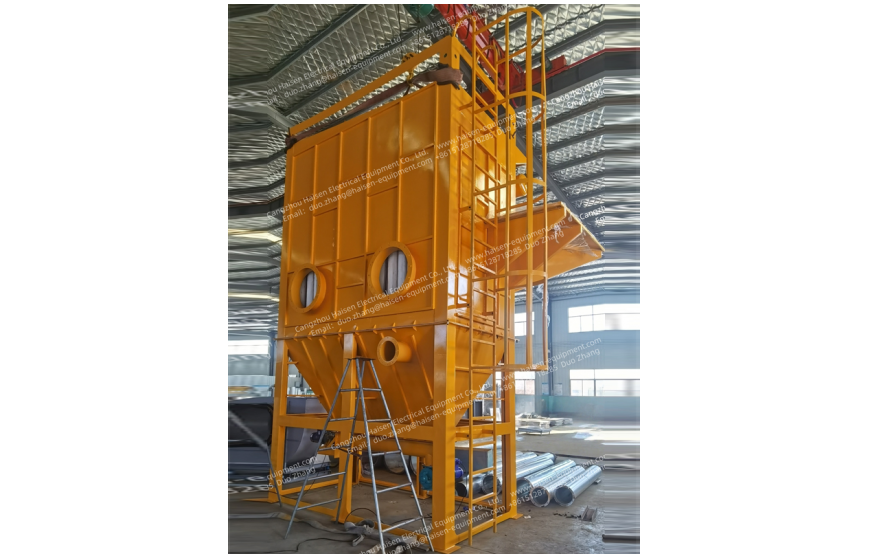
Baghouse Dust Collector
Baghouse Dust Collector — Working Principle
The baghouse dust collector (fabric filter) operates on the principle of fiber filtration, using filter bags to capture dust from gas streams. The process consists of three stages:
Stage 1 — Pre-Separation
Dust-laden gas enters through the inlet and flows into the large-volume hopper. As the velocity drops sharply, heavier and larger particles settle out naturally by gravity, providing initial coarse separation.
Stage 2 — Filtration & Purification
After pre-separation, the gas rises into the filtration chamber containing multiple filter bags. As it passes through the fibrous gaps of the bags, dust particles are retained on the outer surfaces by inertial impaction, sieving, and diffusion/adsorption, forming a dust cake. Clean gas passes through the bag walls, collects in the interior, and is discharged via the outlet. As filtration proceeds, the dust cake thickens and system resistance increases.
Stage 3 — Cleaning & Regeneration
When resistance reaches the preset level, the automatic cleaning system is triggered. Using pulse-jet cleaning technology, high-pressure compressed air is released through pulse valves in a reverse burst into the bags. This causes the bags to expand suddenly and vibrate at high frequency, shaking the accumulated dust cake into the hopper — fully restoring the bags' filtration performance. The entire cleaning process is performed online, with no need to stop the system.
The equipment operates under negative pressure, with the filtration and cleaning cycles managed automatically by a PLC control system, ensuring reliable long-term performance.
Popular recommendation